

How Soft Hair Can Damage a Hard Steel Edge
Hair is much softer than steel. Yet a steel cutting edge can lose useful performance while cutting it. The interesting part is that this need not happen through a neat, gradual rounding of the entire edge.
If you treat every disappointing cut as ordinary dullness, you may miss a more local problem—and ask sharpening or adjustment to solve the wrong thing.
Soft material can expose a hard edge's weak points
Roscioli and colleagues investigated steel cutting human hair using interrupted tests and cutting experiments inside an electron microscope. Their work identified cracking associated with spatial variation in the steel's martensitic structure before appreciable wear had developed. The study concerned razor-type cutting, not a VUNRO clipper trial. It cannot tell us how many grooms a blade should last. It does show why relative hardness alone does not explain an edge's service life. Read “How hair deforms steel”.
Separate a local fault from a whole-setup problem
When performance changes, record where and when you notice it. Does the problem seem confined to one part of the blade's width? Does it occur across an accessible prepared area, or only in a difficult change of coat direction? Was there a recent drop, impact or change of clipper?
These observations do not diagnose microscopic cracking. They give a competent service provider a much better starting point than “it has gone blunt”. A blade that looks normal to the naked eye can still need assessment.
Stop using a blade that pulls or behaves unpredictably. Complete the permitted cleaning and maintenance checks away from the dog, then inspect under suitable light without running fingers along the teeth. A damaged tooth, loose part or unresolved fault takes the assembly out of service.
Do not confuse a new cutter with a new complete assembly
A clipper blade contains interacting parts. Replacing the moving cutter does not automatically correct damage elsewhere, restore alignment or make an incompatible combination suitable.
When ordering a replacement cutter, identify the exact blade assembly and the cutter specified for it. Match the series, width and other model requirements shown on the product page. If you are uncertain, send photographs and the blade details through our contact page before ordering.
A spare complete blade may be the better operational choice when a suspect assembly needs professional assessment. That keeps the decision about repair separate from the immediate need for dependable equipment.
Use the service history to choose useful spares
Track the model, first-use date, maintenance, impacts, service work and reason for removal. Count actual working use where practical; a blade sitting in a drawer for six months has not had the same history as one used throughout the week.
Do not create a promised replacement interval from a few examples. Your own records can still reveal which lengths are repeatedly unavailable when you need them. Those are sensible candidates for a second serviceable assembly.
Width remains a compatibility decision
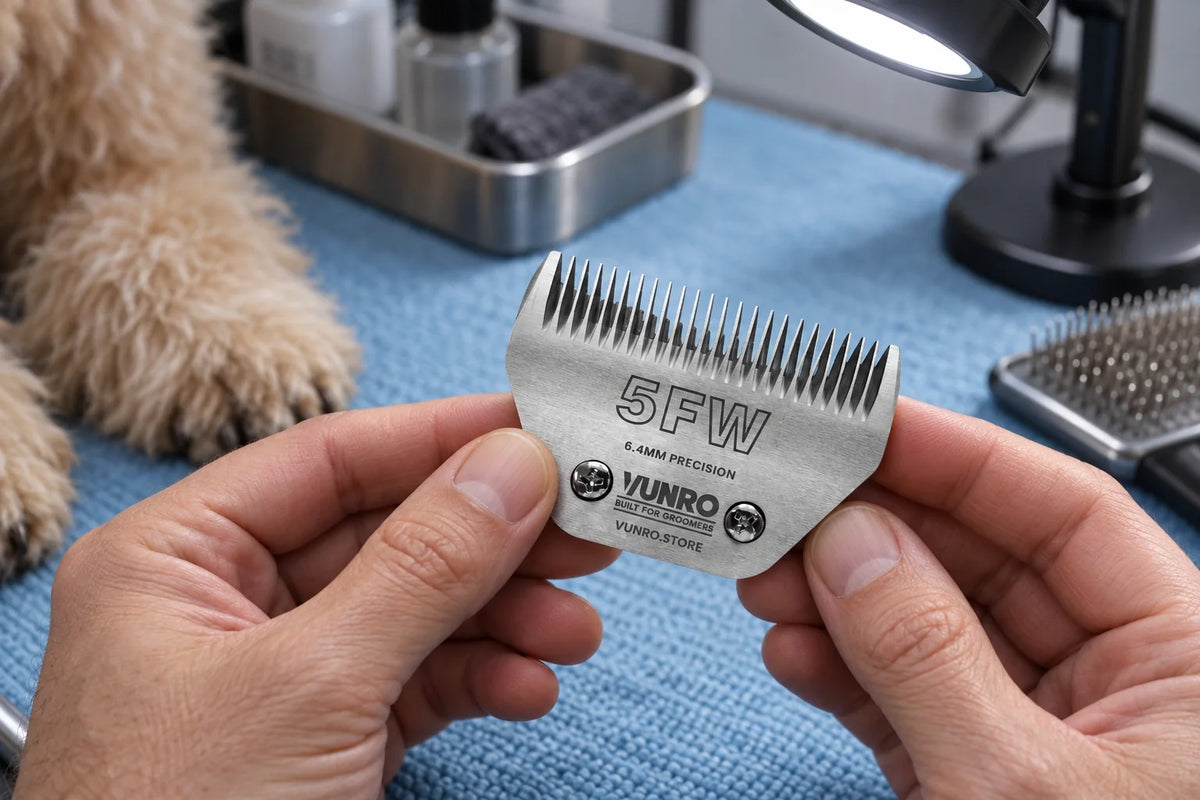
The blade pictured is the VUNRO #5FW Wide Steel Blade, with a nominal 6.4 mm cutting length. It is a wide A5 option. The standard-width #5F is a different width, despite its matching stated length. Their cutters and accessories should never be treated as interchangeable simply because the number starts with 5.
For a wider look at material selection, read our guide to ceramic and steel cutter properties. Hardness is one part of the story. Geometry, condition, fit and the way the assembly is used still matter.
Keep learning
More from the Blade Blog
Explore coat care, equipment guidance and practical grooming routines in the complete guide library.
Browse all grooming guides →


